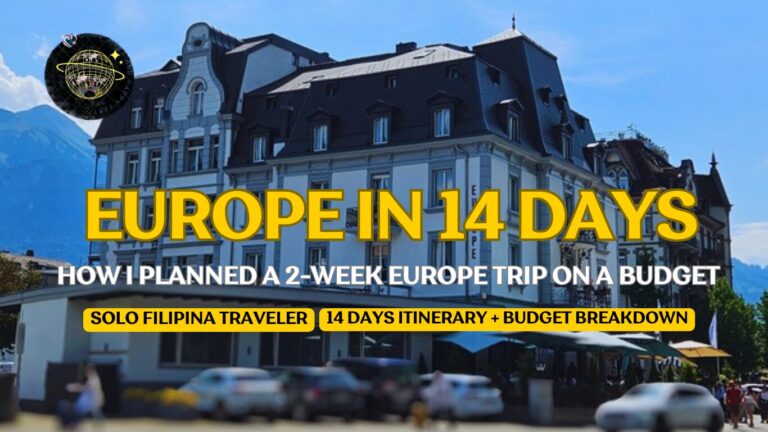

Two weeks, three countries, countless adventures and all on my own! As a solo female traveler, I set out to explore the streets, flavors, and tourist spots of parts of Europe, from the ancient ruins of Athens to the canals of Navigli, the mountain views of Switzerland, and the buzzing streets of Rome.
I embarked on a two-week European solo trip, visiting various parts of three countries and creating many memories.
In this blog, I will share my whole experience, guides for staying safe as a female solo traveller, and how I got my Schengen visa as a Philippine passport holder.
Continue reading to find out!
How I Got My Schengen Visa Approved

During the time I applied, I was living in Dubai. I applied through VFS Dubai and paid a visa fee of AED 382 or around USD 103.98.
I know how nerve-wracking and anxiety-inducing applying for a Schengen visa is, but with both prayers and preparation, I got a favourable result.
Here are some of the documents that I prepared and submitted:
- Greece appointment letter
- Filled out application form
- Cover letter
- Proof of civil status (birth certificate photocopy)
- 2 Passport photos
- Valid passport (atleast 6 months valid). This must include your old passport and the previous visas and stamps there.
- Schengen health insurance
- Resident ID
- Round-trip flight itinerary
- Travel itinerary
- Proof of sufficient financial means (current bank statement of the latest 6 months)
- Proof of accommodation
- Employment contract
- No objection certificate from employer
Depending on your personal circumstances, you might need to pass more documents to prove your ties to your country of residence.
If you are second-guessing planning your solo European trip due to possible visa issues, I advise you to still take the chance. Who knows? You might be approved, too!
And to provide you with more information and tips for your own application, I wrote a (very) detailed blog about my own application.
I shared the story of how a small mistake can cost so much in visa applications, and how you can prevent it from happening to you. You can read more about it here.
I also recorded a vlog of the whole process up to the opening of the package containing my passport. You can watch it here.
SIM Card: Staying Connected in the Schengen Zone

In this day and age, connectivity is a must-have. Especially so if you are a solo female traveller.
I used my Ukrainian SIM card and used Lifecell’s data package for only $2. With this, I got 15 GB of mobile data and 500 minutes of local calls for four weeks. This saved me from buying a local sim card or an e-SIM.
However, if that is not an option for you, buying a prepaid SIM card is relatively easy. These kiosks are common in any airport, so you will not have a hard time finding them.
In Greece, I would recommend Cosmote, as it has the largest and most reliable network coverage, including remote areas and islands. Vodafone comes a close second, and Nova is a good option, but may be less reliable in some remote areas.
Don’t want to buy a physical SIM? Don’t worry, you can also use e-SIMs if your phone supports that. I recommend using the following providers:
- Airalo: Has a lot of affordable eSIM plans for Europe. It has county-specific or regional packages if you are also going to multiple European countries in one trip
- Holafly: This package is ideal for high-data users as it offers unlimited data plans in several European countries
- Simoptions: Has varied data plans, and provides an option for a physical SIM if needed
To have a hassle-free experience in using e-SIMs, I recommend researching more about the activation process, coverage, data limits, and international support/contact numbers if ever you need any technical support.
To summarise:
- If you already have a SIM card and a plan that is compatible with the Schengen Zone, then use that and avail yourself of the plan. This is what I did with my Ukrainian SIM card.
- If you want the physical card that you can slot into your phone, or you have an extra slim slot, then a physical SIM card is perfect for you.
- If your phone supports an e-SIM and/or you don’t want to remove your physical SIM card, I recommend checking Airalo, Holafly, and Simoptions and their packages.
Euro: The Currency in the Schengen Zone (Mostly)

Did you know? Not all the countries in the Schengen Zone use the Euro as their currency.
For example, Hungary uses the Hungarian Forint (HUF) and Switzerland uses the Swiss Franc (CHF).
For this trip, I went to Greece, Switzerland, and Italy. It was Euro (€) for Italy and Greece, and Swiss Franc for Switzerland.
Currency exchange offices are all over airports, train stations, and around the city. They are usually in the city centres, but they usually have high fees.
I advise you to compare rates first, or research which exchange office is best. I recommend using Wise (formerly TransferWise) to help reduce conversion costs.
It is a multi-currency card, so you can hold and manage money across 40-50 currencies, so you won’t have any hassle using both EUR and CHF or other European currencies.
Pre-Travel Reminders: Top 7 Important Tips for Your European Solo Trip
#1 Plan according to the Schengen Visa rules

The Schengen visa comes with rules, especially with the country of entry and the number of days allowed in the Schengen zone.
I have a Philippine passport, and I needed to apply for a Schengen visa. I applied to the Greek VFS Center at Wafi Mall, Dubai.
The official rule is you must apply to the VFS center of:
- The country where you will stay the longest.
- The country of first entry, if your trip involves equal time in multiple countries.
Adhering to this rule is crucial, as your travel itinerary and point of entry should match what you declared in the visa application.
Border control in the Schengen zone might ask questions regarding your plans and how long you will be staying.
#2 Prepare clothes according to the weather

Europe has four seasons throughout the year. Depending on which time you are going, it is best to dress according to the weather.
Dubai has high humidity all year round, which was a stark contrast to the weather in Switzerland when I arrived. It was sunny but also a little bit chilly especially in the Matterhorn area, so I prepared some throw ons to prevent being chilly at night.
Knowing the timeline of your trip will help you in preparing the correct outerwear, especially if you are going in winter. Some countries, such as the northern part of Italy, could be as cold as -5oC.
#3 Beware of pickpockets and scammers

Don’t get me wrong, Europe has a lot of beautiful sights and I really enjoyed my time there. However, as a solo female traveller, I’m here to warn you about pickpockets and scams.
Tourist spots have pickpockets roaming around and waiting for unaware tourists. Be vigilant, especially in crowded spaces, public transport, and other areas where it is known for thieves to operate.
Unfortunately, Europe is infamous for pickpockets who are really, really good. In Italy, they blend in by wearing nice clothes, working in groups, and causing distractions while another takes your valuables.
To stay safe, avoid carrying large amounts of cash. Only withdraw what you’ll need for a day or two. Keep your phone and ATM cards in a money belt worn close to your body, and make sure it is well hidden.
Fortunately, Europe has a wide coverage of contactless payments for convenient transactions. Some just use their Google Wallet cards so they don’t have to carry physical bank cards.
Lastly, I want to remind you about the scams. Common ones include fake charity petitions or “friendship bracelets”, where scammers will tie a bracelet on you and demand payment in exchange.
Trust your gut feeling and in sketchy areas, don’t talk to strangers – especially when you are near ATMs or ticket counters.
I’ve also published a new article on the most common travel scams and how to avoid them. You can read it here: Most-common-travel-scams-and-how-to-avoid-them/
#4 Learn some basic catchphrases in the local language

As a solo traveler, I found that learning some words or phrases in the local language significantly impacted my trip positively.
Not only is it a sign of respect, it also helps in creating a more meaningful connection with locals, even in just fleeting conversations in restaurants or on the streets.
Make sure to learn the equivalent for the following words:
- Good morning/Good day
- Hello/Hi
- Goodbye
- How much is this/that?
- Thank you/You’re welcome
Locals appreciate your effort in learning the local language, and believe it or not, it could even give you some unique insight about the area.
#5 Carry a water bottle

One cost that could exponentially increase during a trip is buying water bottles in convenience stores. A euro here or there might not be noticeable, but believe me, it adds up pretty quickly.
This is super important if you are going during the summer months, as Greece and Italy can become pretty humid.
From my experience, touristy spots like Italy and Switzerland tend to have a lot of water fountains.
With this trick, you will be saving yourself from the hassle of finding a convenience store for water and the extra cost.
#6 Find creative ways for your pictures

One major dilemma of solo travellers is figuring out how to get those Instagrammable pictures. Believe me, I understand. There are just certain angles that are better when you have someone else taking the pictures for you.
Over the years, I’ve found a few tricks to get good solo travel photos.
First tip: bring a tripod! If you have a Bluetooth clicker, even better. I don’t, so I just set the camera timer and run into the frame. Works every time!
My second tip is to buddy up when you are in hostels. In this way, you’d gain new friends, and you can take each other’s photos too!
Sometimes, being solo means you have to get a little help. I know this is not possible in some places especially if the crime rate is high, so you should always be careful who you ask.
That’s why my third tip is to ask a fellow tourist (especially Asians) to take your picture. It can actually be really practical and useful because most tourists understand the struggle of solo shots and are glad to do a small favor.
If you are on a group tour, you can ask other people around you, and offer to do the same.
There are a lot of people who will be kind enough to lend a helping hand. Just make sure to express your gratitude afterwards.
#7 Maximise your passes

Tourist places would often have ‘passes’, which are bundles or packages of all the usual tourist spots. This may also include transport cards, which are super convenient.
These can be ‘day passes’, which are perfect if you are exploring a place for 1-3 days. Some examples include the Milan Pass and the Roma Pass. This would give you access to over 100 tourist attractions, and may also include public transport.
Another type would be the Swiss Travel Pass. This one is mainly a transport card, wherein you have unlimited train tickets all over Switzerland. But it also includes discounts and free museum entry.
My entrance fee for Harderkulm in Interlaken was supposed to be 40 CHF. But, since I have the Swiss Travel Pass, I got a 50% discount, and I only paid 20 CHF.
The Swiss Travel Pass looks very expensive at first glance, but believe me, you are saving money. I stayed in Switzerland for 6D5N, and I was able to maximise my Swiss Travel Pass by entering museums, going to various parts of the country, and using the local public transport.
14 Days in Europe: My Solo Travel Experience
Day 1 to 4: Athens, Greece

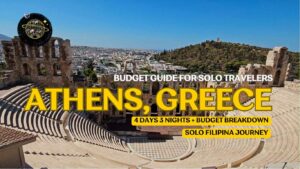
If I were to describe Greece in three words, it would be vibrant, historical, and warm.
Greece has so much to offer. I went to ancient structures such as the Acropolis Hill (which houses various temples such as the Parthenon), the Ancient Agora, Hadrian’s Library, and so much more. I wrote more details about all the places I visited on my blog here.
These are places that I only read about before in history books, and I was in awe seeing their scale and grandness in person.
Since this is a budget trip, I opted to do couchsurfing, and luckily, I found a great female host who definitely enhanced my experience, especially when we went to a local market and met her friend in a restaurant. You can see my whole experience in my Athens vlog here.
You may be wondering, “What is couchsurfing, and how can I do it too?” To sum it up, it is staying temporarily in a person advertising a free room or lodging in their house, and it has connected me to some like-minded people in the world.
My first couchsurfing experience in Nepal enabled me to get an insider glimpse of how a local sees their own country. It has been a great experience, and I did it again on my trip to Athens.

And of course, I wouldn’t forget to mention Greek cuisine. The food in Greece reflects the warmth of the people there. The Mediterranean diet might look simple, but it is super healthy and made of fresh ingredients.
I got to try local foods such as souvlaki, which is the Greek version of kebab. For drinks, I recommend trying tsikoudia. This traditional drink comes from the island of Crete, has fruity hints, and can be very strong. Even if you’re not a big fan of strong spirits, trying tsikoudia is a must-do for an authentic Greek experience.
Overall, Athens, Greece, was a great introduction to my 2-week European solo trip.
Greek people are generally warm, welcoming, and hospitable. It reflects the vibrant culture and sunny weather I experienced there. And of course, getting to visit its ancient architecture and see it with my own eyes was really unforgettable.
Day 4 to 7: Milan, Italy

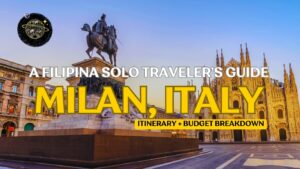
After the scenic landscapes of Greece, I was treated to the picturesque beauty of Milan. You might have seen ‘aesthetic travel photos’ of Milan on Pinterest or Instagram, and it is also stunning in reality.
I visited the famous Duomo di Milano, which you might have seen in some Filipino movies. I also went to Galleria Vittorio Emanuele II, which is known for its beautiful central dome and high-end brands.
Castello Sforzesco is an absolute must-visit when in Milan! This historic fortress dates back to the 15th century and is packed with incredible museums, beautiful courtyards, and stunning art collections. It’s a place that truly brings Milan’s rich history to life.
One of my most memorable moments in Milan was simply resting overlooking the Bosco Verticale and the Navigli Canal.
I appreciate modern sustainability and the futuristic aesthetic of the Vertical Forest, and sunsets in the Navigli Canal are a perfect way to end the day. I included a much more detailed itinerary in my Milan blog here.

I loved watching street performances in Milan. It gave me a deeper appreciation for the culture of the place, and it made me realise that so many people are talented, too. For me, this is the perfect way to spend some downtime.
And of course, I would never forget to mention Italian cuisine. On my first day, I indulged myself with black truffle spaghetti paired with Pinot wine. Did I mention that I had a fantastic view of the Duomo from Restaurant Obica’s rooftop terrace?
An important thing to remember is that restaurants close between meal times, so it is better to plan where you are eating ahead. There is also a coperto, on your bill, which is the cover charge.
When it comes to dining, Italians like an unrushed and calm meal, so be respectful by not rushing through your food.
Don’t ask for changes when it comes to traditional dishes, such as adding cream to carbonara. Italian chefs pride themselves on the traditional way of cooking – especially with pasta – and this is considered offensive to them.
Other than that, enjoy the super-duper-good Italian cuisine, and of course, the intricate beauty of Milanese architecture.
Day 7 to 12: Switzerland

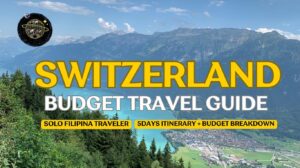
Have you ever looked at a landscape that is so beautiful, you begin to wonder if it is real or made by AI? That’s exactly how I felt when I was in Switzerland. It’s so beautiful and picturesque that I am convinced everyone has to go to Switzerland at least once.
In five days, I visited Bern, Zermatt, Interlaken, and Geneva. The high-speed trains in Switzerland are so convenient, and I was able to maximize the Swiss Travel Pass as well.
Every part of Switzerland has its own charm. In Bern, I was able to see a bear in the BärenPark, and in Zermatt, I saw the famous Matterhorn, Matter Vispa, and traditional houses.

In Interlaken, I couldn’t miss the chance to ride the funicular up to Harder Kulm and take in the stunning beauty of the Alps—it felt straight out of a postcard.
I was gifted with the perfect viewpoint of both Lake Thun and Lake Brienz. If you like watching Korean dramas, you must have seen these beautiful lakes there. By the way, it is important to bring your ID as this is checked when buying tickets.
I saved Geneva for last… and it turned out to be a total hidden gem! You can see more of this story on my vlog.
For me, Geneva definitely exceeded my expectations. I know Geneva as the home of international organisations, like the United Nations and the Red Cross. But believe me, it is so much more than that.
I enjoyed relaxing in Lake Geneva, and after roaming around the tourist spots, I relaxed in the Sirene de Collonge-Bellerive, or Mermaid of the Lake. It was a great way to end the day and to reflect on what this trip has taught me so far.
I’m so grateful to all my hosts in Switzerland. It is one of the most expensive countries in the world, so I am fortunate enough to have hosts who accommodated me during my trip.
As for food, affordable choices are the supermarket chains and convenience stores such as Denner, Coop, Migros, and Migrolino. I prepared a more in-depth Switzerland guide containing more tips and tricks for you here.
Day 12 to 14: Rome, Italy

Is it really a solo European trip without roaming Rome? With all its historical landmarks, I would not miss Rome for the world.
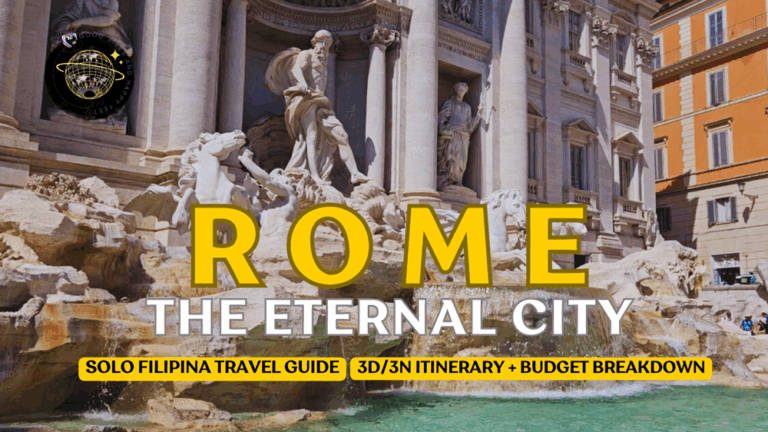
In three days, I visited the Vatican City (which is another micro-state, by the way), marvelled at the Colosseum, and took Instagrammable pictures at the Trevi Fountain.
Whenever I travel, nature is always a safe space. I would always gravitate towards green spaces, and that’s how I found Bioparco di Roma – the oldest zoo in Italy with more than 1,100 animals.
If you are looking for a cost-efficient way to see the most out of Rome within a budget, go for the Roma Pass. For me, the Roma Pass is worth it, especially if you’re planning to rely heavily on public transport.
The pass includes special entrances and skip-the-line lanes, so it will save you a lot of time. It also includes entrances to the Colosseum (€18) and the Capitoline Museums (€13). You can read about this more in my blog.

When it comes to Italian food, I would say that Rome has one of the best cuisines – especially desserts. A gelato spot named Hedera serves the best gelatos and crepes.
With its beautiful places and delicious food, it is easy to get distracted by everything Rome has to offer. However, as a solo female traveler, safety is our priority.
Like any other big city, Rome has its fair share of petty crimes and dodgy areas. For starters, always be alert and vigilant in public transportation.
Locals are getting affected by pickpockets, so be watchful of your belongings when you hear someone say ‘Attention, pickpocket!’.
It is better to be safe than sorry. There is no greater hassle as a solo traveller than losing your phone, wallet, money, or even your passport. The good thing is, you can prevent this by staying on your guard.
But, don’t let this ruin your Roman holiday. Pickpockets and dodgy areas aside, Rome will always be a beauty to behold.
As the last stop in my solo European trip, Rome provided the perfect ending. A mixture of grandiose, high-ceiling art by famous painters, and the calm, peaceful refuge of natural parks.
I was both in awe and filled with gratitude. The past fourteen days of solo travelling through three European countries have challenged me and made me grow as a person. And I wouldn’t have it any other way.
Two-Week Itinerary + Cost Breakdown
| Day | Activity | Cost (all in EUR) |
| ATHENS, GREECE | ||
| Day 1 | Flight: Abu Dhabi to Athens via Wizz Air | € 104.04 |
| Meet my couchsurfing host | ||
| Dinner | ||
| Rest | ||
| Day 2 | Breakfast | |
| Visit the wet market with my host | ||
| Lunch | ||
| Visit a clinic | ||
| Dinner (Pasifai Restaurant, Glyfada) | € 2 | |
| Day 3 | Metro: Piraeus to Acropolis *This is a single-day ticket, valid for 90 minutes. | € 1.20 |
| Entrance fee: Acropolis (Combined ticket) | € 30 | |
| Explore The Acropolis Hill | ||
| Visit Happy Blender and bought a juice (Juice of the Day: Watermelon, Banana, Ginger, Apple) | € 5.50 | |
| Lunch | € 16 | |
| Buy ice cream at Ellyz Cafe | € 7 | |
| Buy souvenir at Adrianou Street | € 3 | |
| Buy fridge magnet at Flea Market | € 2 | |
| Metro to Piraeus | € 1.20 | |
| Metro: 24-hr Ticket | € 4.10 | |
| Topped up Maria’s Ath.ena Card*Ath.Ena Card is a reloadable public transport card. You can find more information here. | € 5 | |
| Day 4 | Cook breakfast | |
| Dropped off at the bus station by my Host | ||
| Bus Ticket: Athens to Airport | € 5.50 | |
| Sausage Croissant + Hot Chocolate | € 7.60 | |
| ATHENS TOTAL COST | € 194.14 | |
| MILAN, ITALY | ||
| Day 5 1:00 am | Flight: Athens to Malpensa Airport T2 (Easyjet) Cabin Bag Charge | € 80.98 € 33.99 |
| 5:30 am | Malpensa Bus Shuttle: Fiumicino Airport to Milano Centrale *Note: A ticket only costs €10. I initially booked a Terravision bus ticket online, but I missed it, so I had to buy a new one. | € 10 x 2 = €20 |
| 7:00 am | Accommodation: Check in at Ostello Bello Grande (3D2N) *including € 9.98 additional charge | € 119.76 |
| 7:20 am | Rest and sleep | |
| 2:00 pm | Explore Piazza Del Duomo | |
| 5:30 pm | Dinner: Obica Restaurant (Black Truffle Spaghett & Pinot Wine) | € 31 |
| 6:00 pm | Visit the Hall of Fame | |
| 7:00 pm | Visit Starbucks Reserve Roastery | |
| 8:00 pm | Return to hostel and socialise with other travelers | |
| Day 6 9:00 am | Extended hostel stay for one more night | € 45.44 |
| 10:00 am | Breakfast in the hostel | € 6.90 |
| 11:00 am | Metro to Castello Sforzesco (Bought 2 metro tickets) *A single ticket costs € 2.20 and is valid for 90 minutes. | € 4.40 |
| Explore Castello Sforzesco | ||
| 1:00 pm | Explore Pinacoteca Di Brera | |
| 2:00 pm | Stop by Chiesa Di San Marco | |
| 3:00 pm | Explore Piazza Gae Aulenti and Porta Nuova Food District | |
| 5:00 pm | Relax at the park with the view of Bosco Verticale | |
| 5:30 pm | Explore Navigli Canal | |
| 8:00 pm | Metro: Back to Milan Centrale | |
| 8:30 pm | Dinner at Sagami | € 18 (inclusive of €2 service charge) |
| 10:00 pm | Rest and Sleep | |
| Day 7 7:00 am | Check out of hostel | |
| 8:20 am | Travel from Milano Centrale to Geneva *included in the next computation | |
| MILAN TOTAL COST | € 360.47 | |
| 6D5N Cumulative Total | € 554.61 | |
| SWITZERLAND | ||
| Train from Milano Centrale to Geneva (CHF41.26)* *All CHF values are at the conversion rate when I make the transaction. | € 44 | |
| Buy food from Migros (CHF 9.10) | € 9.72 | |
| Buy Swiss Travel Pass (CHF 281) | € 300.02 | |
| Train: Geneva to Bern | ||
| Arrived in Host’s Place | ||
| Day 8 | Explore the following tourist spots in Bern: – Bernisches Historisches Museum- Aare River- Zytglogge Clock Tower- Rathaus- Church of St. Peter and Paul – Old Town – BärenPark *The entrance fees in some attractions are included in the Swiss Travel Pass. | |
| Train: Bern to Zermatt *All train travels within Switzerland are included in the Swiss Travel Pass. | ||
| Meet host | ||
| Day 9 | Explore the following tourist spots in Zermatt:- Matterhorn and Matter Vispa- Zermatt Traditional Houses – Zermatt City Centre | |
| Train: Zermatt to Interlaken | ||
| Buy food in Migrolino (CHF 2.75) | € 2.94 | |
| Luggage Storage at Interlaken Ost (CHF 5) | € 5.34 | |
| Stroll around Interlaken | ||
| Visit Harder Kulm (CHF 20) *The entrance fee is CHF 40, but the Swiss Travel Pass provides a 50% discount. | € 21.35 | |
| Pick up luggage | ||
| Train: Interlaken to Geneva | ||
| Meet host and dinner | ||
| Day 10 | Explore the following tourist spots in Geneva: – Lake Geneva – Jardin Anglais – Ride the Ferris Wheel (CHF 8) – Jet d’Eau – Savonniere Beach – La Plage de la Nymphe | € 8.54 |
| Buy food at Savonniere Beach: Pizza (CHF 12) + Popsicle (CHF 4.50) | € 17.61 | |
| Dinner with host | ||
| Day 11 | Eat at McDonald’s (CHF 2.50) | € 2.67 |
| Visit Brunswick Monument | ||
| Cottage Cafe Gelato (CHF 8.44) | € 9 | |
| Stroll around the lake | ||
| Departure | ||
| SWITZERLAND TOTAL COST | € 421.19 | |
| 10D9N Cumulative Total | € 975.80 | |
| ROME, ITALY | ||
| Flight: Geneva to Rome Fiumicino Airport (I arrived at 11:49 PM) | € 287.44 | |
| Bus: Fiumicino Airport to Rome Termini Station | € 8 | |
| 24H Bus Ticket from Roma Termini to Mama Shelter Roma (my accommodation); €7 x 2 | € 14 | |
| Check in to Mama Shelter & Meet Host | ||
| Relax and Sleep | ||
| Day 12 10:00 am | Wake up | |
| Breakfast with host | ||
| Roam around Rome and visit the following spots:- The Vatican Museum – St. Peter’s Square – Trevi Fountain – Pantheon – Piazza Navona | ||
| Snacks (Gelato and Mochi) ℅ Host | ||
| Visit Bioparco di Roma ℅ Host | ||
| Dinner at the hotel’s rooftop restaurant | € 55 | |
| Night swim | ||
| Relax and sleep | ||
| Day 13 7:00 am | Wake up | |
| Check out and transfer to the Centro 1 Hostel ℅ Host | ||
| Breakfast ℅ Host | ||
| Explore Colosseum | ||
| Dinner at Osteria Da Fortunata | € 17 | |
| Hedera Ice Cream | € 6 | |
| Watch street performers and artists | ||
| Stroll around Castel Sant’ Angelo and Piazza Navona | ||
| Return to the hotel | ||
| Relax and sleep | ||
| Day 14 6:00 am | Wake up | |
| Check out from Centro 1 Hotel | ||
| Bus to Airport | € 6 | |
| Flight: Rome to Abu Dhabi/Dubai | € 205.46 | |
| ROME TOTAL COST | € 598.90 | |
| 14D13N Cumulative Cost | € 1,574.70 | |
Budget Talk: How Much Did I Spend in a Two-Week European Solo Trip?

Including flights to and from Abu Dhabi, accommodation, and the day-to-day expenses, I spent a total of € 1,574.70 for 14D13N in Europe.
As a budget traveler, I can say that I was able to keep within my target amount. Most of my expenses are flights and transport cards, while I have saved a lot in accommodation due to couchsurfing and Host-a-Sister.
In Switzerland, I saved money as I had hosts all throughout my stay. I also had hosts in Athens and Rome. Looking back, I only paid for a hostel in Milan. I consider myself very fortunate to have had people who were willing to host me in their homes. I talk more about Couchsurfing in this blog.
Switzerland is the most expensive country in Europe, and one of my tips for you is to buy your food in supermarkets or big chains like Lidl, Migros, Coop, and Migrolino. If you can, I advise you to cook your meals. One meal in Switzerland ranges from CHF 20 to CHF 70, and this will add up quickly.
Frequently Asked Questions (FAQs)
What are my chances of getting approved for a Schengen visa?
Approval for a Schengen visa depends on a lot of factors. To give you some good examples, I’m going to list some possible reasons that an application will be rejected.
The visa officer thinks that:
- The application is incomplete, or the travel document is invalid;
- There is a lack of proof of your purpose to stay.
- Your funds are insufficient.
- Your visit is not genuine, or you have an unreliable travel history.
There is no one-size-fits-all solution to ensure a Schengen visa approval, especially since immigration laws and rules often change. What you can do as an applicant is to ensure that your documents are complete, consistent, and valid.
You can check out the vlog for the documents that I submitted on my Schengen visa application here.
Is it possible to go to Europe on a budget?
Of course! As you can see from my solo trip, I spent €1,574.70 for two weeks. This is already within the affordable range, given how expensive Europe can be, especially Switzerland.
The big cost that I saved on is accommodation. As a solo traveller, hostels in Europe can cost between €25 to up to €50 per night during peak seasons. For 13 nights, that could have been an additional €325 to €650. I got lucky that I found hosts who were willing to host me for free.
In terms of food, I made sure to buy from big supermarket chains like Lidl, Migros in Switzerland, and the like. This kept my food expenses to a minimum, given that I am not eating out for every meal.
One meal in Europe can range from €15 to €40 per person. In Switzerland, this can go even higher. In my vlog, you can see that I bought bananas and bread in the supermarket. This really helped keep the costs down, since a meal in Switzerland usually starts from €30.
During the first few days of my travel, I plan to budget carefully on meals to manage expenses, focusing on affordable options. Towards the end of the trip, I intend to enjoy local specialties and dine at recommended local spots, prioritizing quality and authentic experiences with or without my host.
Is Couchsurfing safe?
As a solo female traveller, safety is my #1 priority. Couchsurfing is safe when done right.
If you have been following my vlogs, you’d see that most of my hosts are women. I also make sure to connect with them before my trip so that we can get to know each other first.
Websites such as Couchsurfing and Host a Sister are great places to start. They verify hosts and members to maintain safety within the group. Joining legitimate websites and groups such as this is step one to ensuring your safety.
As much as we’d love to save money and make our trips super affordable, it is our responsibility to make sure that we are safe.
When you connect with hosts, verify their identity online, build rapport with them, and get to know them before your trip. Not only will this remove any awkwardness when you meet in person, but it also gives you the assurance that you are safe.
Are there a lot of pickpockets in Europe?
European cities are a blend of different cultures and people. As much as we want to completely enjoy our vacation, solo travellers like us need to be more vigilant.
Tourist places such as Paris, Barcelona, Rome, and Milan have become infamous for pickpockets. It has reached a point where even locals are affected. And yes, there are a lot of pickpockets in Europe.
To protect my valuables, I would buy a small, sling bag that I could put underneath my clothes. I also do not travel with expensive jewelry, luxurious clothes, or other items that are ‘eye-catching’ for pickpockets.
What should I bring in my luggage?
As a light packer, I only bring what is essential for me during my trip. Prepare clothes or outfits that are appropriate for the season you are travelling in.
Another must-have are your medicines. If you have medical conditions that require you to bring some medicines, then make sure to pack them. Don’t forget to bring your prescription as well.
European countries are very strict when it comes to what you can bring and what is prohibited. You can check this list of the consumer goods you can carry in your suitcase.
You can also check with your airline what they allow. Different airlines have different rules. In the same way, if you are transiting in another country, it is also better to check that country’s rules.
How safe is Europe for solo female travellers?
Europe is generally a safe place for solo female travellers. However, there are still some precautions that we need to practice in order to avoid trouble.
When booking your accommodation, it is super important to check its location before paying. Research about the location, which area it is located in, and if it is safe there.
Check the reviews thoroughly. Some red flags are when reviews include something like “located in a dark street with no street lights” or “located in a chaotic neighborhood”. Europe has some dodgy areas that you don’t want to visit, much less sleep in.
If you are staying in hostels, buddy up with someone if you are doing nighttime activities, like barhopping or going to clubs. The same goes for activities in nature, such as hiking unfamiliar trails, swimming, and diving.
I want to travel solo, but I’m nervous. What should I do?
Solo travelling is its own sport, and I can say that it is not for everyone. But, before you make any decisions, it is best to know if it is for you.
One advice that I would give is to ‘try’ it first. Don’t go on two-week trips right away, as this might feel really overwhelming for first-timers. Try it first for a weekend, for example. Then go for 5-7 day trips.
You don’t have to go overseas right away for a solo trip. The difference in culture, language, and weather might overwhelm any excitement you have for the trip.
For first-timers, I recommend going to another part of your country first. Having that ‘trial period’ will enable you to decide whether you want to travel solo. It’s outside of your comfort zone, but it will not provide as much of a shock compared to an overseas trip.
Ready for an adventure of a lifetime?
Europe has always been my lifelong dream; experiencing it first-hand is life-changing.
If you have been thinking of going to Europe, may this be your sign to finally push your plans through. The world is big, wide, beautiful, and has a lot of adventures in store for you!
Stop waiting and start planning. Besides, you never know what’s on the other side until you’re there.